Creative Agencies for Musicians, Artists, and Hospitality Brands
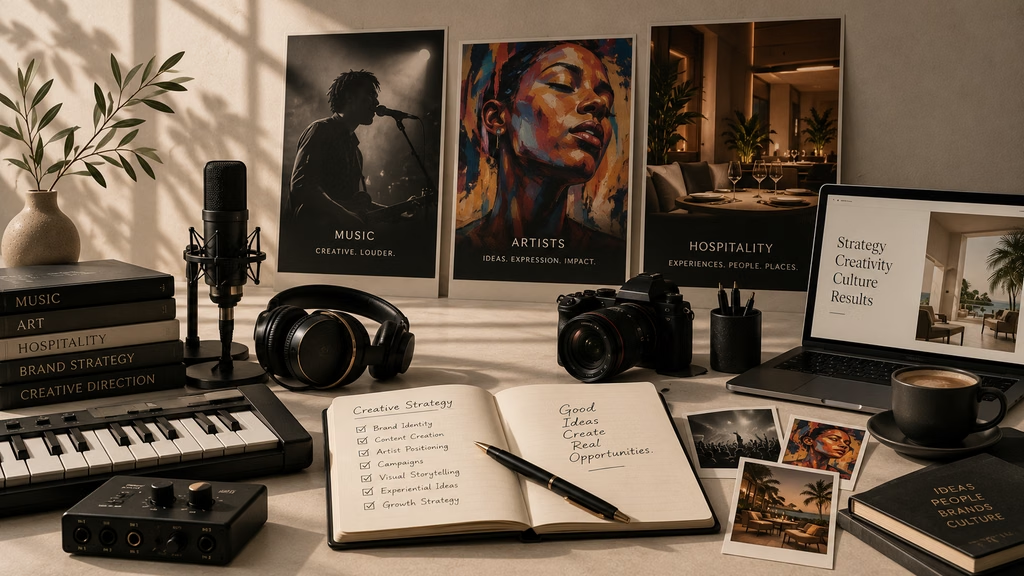
These four categories get grouped together on agency websites and almost never explained. What a musician needs is not what a hotel needs, and neither is what a painter needs.
The differences are concrete. Different deliverables, different platform specs, different lighting, different cadence. This is what each one actually requires, so you can tell whether an agency has done it before.
Key takeaways
- Musicians work to release cycles. Assets are due before the track, not after.
- Spotify Canvas is a 3 to 8 second vertical loop, and footage of someone singing is the wrong choice for it.
- Visual artists need accurate reproduction before they need promotion. Color fidelity is the whole job.
- Hospitality imagery has to survive Google’s reality test, which rules out heavy grading on profile photos.
- Luxury work is defined by what gets left out, and most agencies add.
- Cadence beats production value in all four. Any creative agency for musicians or hospitality brands should be planning a year, not a project.
Where these sectors overlap and where they split
All four sell something intangible, which is why they lean on imagery. The similarity ends there.
| Sector | Selling | Primary asset | Cadence |
|---|---|---|---|
| Musicians | A feeling attached to a track | Vertical video | Per release |
| Visual artists | A physical object seen remotely | Accurate stills | Per exhibition |
| Hospitality | An experience booked in advance | Space and food stills | Continuous |
| Luxury | Restraint and scarcity | Controlled hero film | Per season |
A creative agency for musicians organizes around release dates. Nothing else in the calendar moves. A hospitality agency organizes around occupancy and season. Those are different operating rhythms, and an agency that only knows one will miss deadlines in the other.
Musicians: the release cycle drives everything
A creative agency for musicians is really running a deadline system with a camera attached.
Assets have to exist before the track goes live. Distributors need artwork weeks ahead. Playlist pitching happens before release day. A music video that arrives a week late has missed the window it was made for.
The standard asset set per single:
| Asset | Format | Notes |
|---|---|---|
| Cover artwork | Square | Required by every distributor |
| Canvas loop | 9:16 vertical, 3 to 8 seconds | Replaces artwork in Now Playing |
| Music video | 16:9 | Optional, expensive, not always worth it |
| Vertical cutdowns | 9:16, under 30 seconds | The actual promotion engine |
| Press shots | Stills, varied crops | Blogs, playlists, socials |
| Behind the scenes | Vertical | Fills the gap between releases |
Spotify’s Canvas guidelines are more prescriptive than people expect. It is a short vertical loop shown in place of album artwork, and Spotify advises choosing footage without talking, singing, or rapping, since a 3 to 8 second clip will not sync with the lyrics. It also warns that edges get cropped on some phones and suggests leaving the song and artist name out entirely, because that text already appears in the interface.
That single spec rules out the most common mistake, which is cutting a Canvas from the music video’s most quotable line. A creative agency for musicians that has done this before will shoot dedicated loop footage rather than harvesting it.
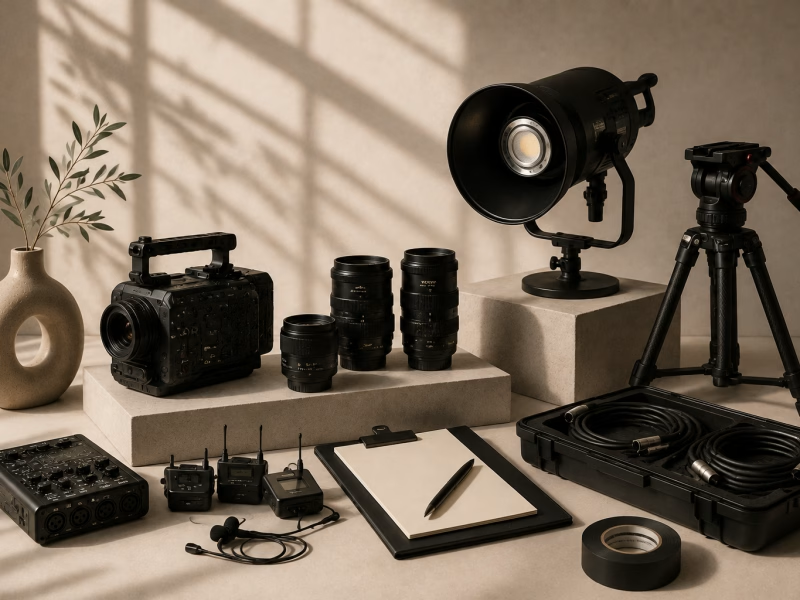
Production for a creative agency for musicians leans on color and movement more than on resolution. RGB tube fixtures like the Nanlite PavoTube 6C do most of the visual work in a performance video, because a color shift reads as a mood change on a phone screen where detail does not. Movement matters equally, and a compact gimbal gives the drift that holds attention through a vertical loop.
For press shots, a fast portrait lens such as an 85mm f1.8 separates the artist from a busy location, which matters because musicians are rarely photographed in controlled spaces.
Any creative agency for musicians should be able to shoot all six assets in the table above from one or two days. If a quote assumes a separate day per asset, the agency has not worked to a release calendar.
Visual artists: documentation before promotion
A creative agency for artists is solving a reproduction problem first and a marketing problem second, which is the clearest split from what a creative agency for musicians does.
The core deliverable is a photograph of an artwork that looks like the artwork. That sounds simple and is not. Even lighting across the surface, no reflection, no color cast, no keystone distortion, and a color reference in frame so the file can be corrected accurately later.
Galleries, grant applications, print catalogues, and submission portals all need that file. Nothing else can substitute for it.
Beyond documentation, three things earn their cost:
- Studio process film. Short, quiet, no voiceover. It is the most shared thing most artists ever publish.
- Exhibition documentation. Install shots, wide and detail, before the opening crowd arrives.
- Artist portrait. One good one, used for years.
A creative agency for artists that treats this as ordinary product photography will deliver files that are unusable for print. Ask specifically whether they shoot with a color target and deliver in a wide color space.
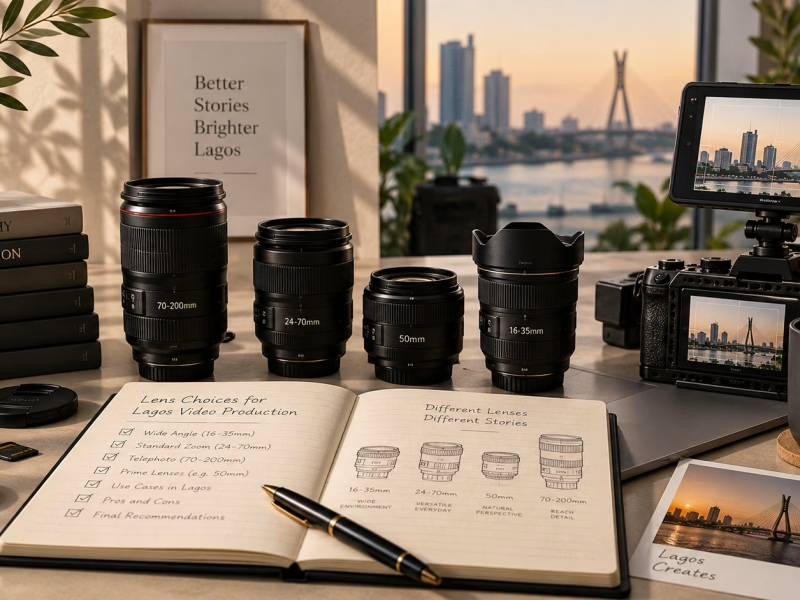
Wider lenses matter here more than long ones. A 35mm covers install shots and studio context without the distortion a wider focal length introduces on straight edges, and the rest of the lens options come down to the size of the work being documented.
One more thing to settle in writing: Nigeria’s Copyright Act 2022 protects artistic works and sets out separate rights in the photograph itself. The photograph of your painting is its own protected work, which means the agreement needs to say who owns it.
Hospitality: rooms, food, and the reality test
A creative agency for hospitality has to shoot for two audiences with opposite standards. Where a creative agency for musicians can stylize freely, hospitality cannot.
The brand channel wants aspiration. The booking channel wants accuracy. Both matter, and the same image usually cannot serve both.
Google is explicit about the second. Its business photo guidance says photos should be in focus and well lit with no significant alterations or excessive use of filters or AI, and that the image should represent reality. Heavily graded interiors that look nothing like the room are a liability on a Business Profile, whatever they do on Instagram.
What a hospitality shoot actually needs:
- Rooms at the right time of day. Interiors photograph best when window light and interior light balance, which is a 30 minute window, not an afternoon.
- Food shot fresh. Fifteen minutes per dish, not an hour. This is a scheduling problem more than a lighting one.
- Empty and populated versions. Spaces read cold without people and cluttered with too many.
- Exterior and approach. How guests recognize the building.
Consistency of color across a full property is the hard part. A bi-color key such as the Amaran 200x lets a crew match to whatever window light exists in each room rather than fighting it, which is what keeps forty images looking like one hotel.
For properties with grounds, a view from above sells scale in a way ground-level work cannot, and an FPV drone moving through a space does more than a static aerial. Any creative agency for hospitality quoting aerial work should also be naming who holds the permits.
Luxury: what gets left out
A creative agency for luxury brands earns its fee by removing things. It is the inverse of the maximalism a creative agency for musicians is often hired for.
The failure mode in this category is addition. More lights, more movement, more graphics, more copy. The visual language of luxury is slow, quiet, and underlit relative to what most brands ask for.
Practical markers of work that understands the category:
- Fewer cuts, longer holds
- Restrained color, often close to monochrome
- Product shown in use rather than explained
- No on-screen text where a caption would do
A creative agency for luxury brands should be able to show you work with obvious restraint in it. If everything in the portfolio is maximal, they will make your brand maximal too.
Cadence beats production value
One consistent monthly output beats one expensive annual film in every one of these sectors. This is the single point a good creative agency for musicians and a good hospitality agency will both make unprompted.
This is the single most common budget mistake, and any creative agency for musicians has watched it happen. A client spends a full budget on one video and has nothing for the next three singles. A restaurant shoots once at opening and posts the same twelve images for two years.
Plan the year, not the project. Two moderate shoot days spread across twelve months will out-perform one large day, because the feed needs feeding and the algorithm rewards recency.
That is also the honest answer for anyone weighing a creative agency for small business budgets against a larger studio. A creative agency for small business work should be proposing a cadence you can sustain, not a single showpiece that empties the budget.
Where branding and social sit
Identity work and channel work are different disciplines with different timelines, and neither is what a creative agency for musicians is usually hired for.
A creative agency for branding builds the system: identity, palette, type, and the rules that keep everything consistent. It happens once and then constrains everything after it. A creative agency for branding that hands over a logo without usage rules has done half the job.
A creative agency for social media works inside that system, weekly. Meta’s aspect ratio guidance recommends different framing across feed, Stories, and Reels placements, which is why a creative agency for social media needs the brand system to include vertical rules, not only print ones.
Most brands in these four sectors need the branding work first and the social work continuously. Trying to buy both from the same retainer usually means the identity gets rushed.
Location and crew
For anything physical, the question is where the crew is, not where the company is registered. This matters more for a creative agency for musicians than for most, because touring moves the work.
Touring musicians and multi-property hospitality groups both need coverage in more than one city. Searches for a creative agency in Abuja usually come from exactly that: a Lagos-based brand needing a shoot up north, or an Abuja venue needing crew that will not bill travel for four people.
Ask whether a creative agency in Abuja or anywhere else staffs that city or subcontracts it. Either answer works. Only the undisclosed version causes problems.
How we work in these categories
We plan the year first, then quote the shoot days that fill it. That holds whether we are working as a creative agency for musicians, a hospitality partner, or a documentation service for a gallery.
For music clients that means mapping the release calendar and building shoot days around it. For hospitality it means seasonal refreshes rather than one opening shoot. If you send us your calendar for the next twelve months, we will tell you how many days it actually needs.
Frequently asked questions
How far ahead should a musician book a creative agency for musicians work?
Six to eight weeks before release. Distributors, playlist pitching, and Canvas approval all sit ahead of release day, and the shoot has to clear all three.
Is a full music video worth the budget?
Often not, for an emerging artist. Six strong verticals usually generate more listening than one video, and they cost less to produce together.
What should artwork documentation cost relative to promotion?
Documentation first, always. Unusable files mean rejected grant applications and bad catalogue printing, and no amount of social content fixes that.
Can one shoot cover both Instagram and Google Business Profile?
Yes, with two grades. Shoot once, deliver a stylised set and a straight set. Google’s guidance asks the image to represent reality, so the profile version needs a lighter hand.
How often should a hospitality brand reshoot?
Twice a year for most properties, aligned to season and any refurbishment. Menus change faster and can be shot in shorter sessions.
Do luxury brands need different crew?
Not different crew. Different restraint. The technical requirements are ordinary; the editorial discipline is not.
Working out what you need
Write down your next twelve months first: release dates, exhibition openings, seasons, or menu changes. The calendar tells you how many shoot days you need and when, and that number is almost always different from the one you would have guessed.
Bring that calendar to any creative agency for musicians, artists, or hospitality brands before you ask for a price. An agency quoting against a year behaves differently from one quoting against a single job, and the difference usually shows up in what they include for free.
Send us that calendar and we will come back with the days, the crew, and what each one produces.