Creative Agencies for Nonprofits and Charities: What’s Different
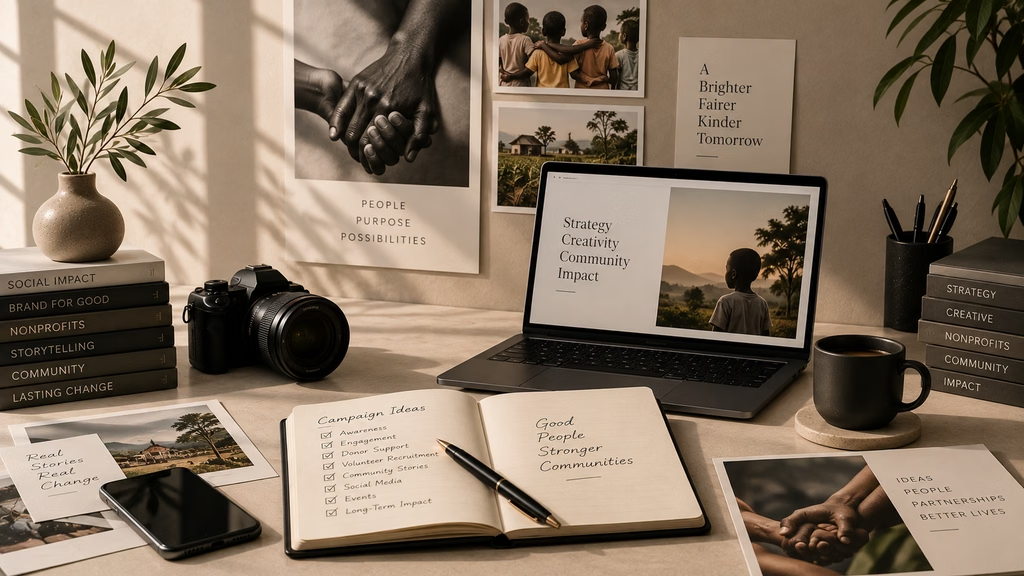
Commercial production optimizes for attention. Nonprofit production has to optimize for attention without harming the people in the frame. Those two goals pull against each other constantly, and the sector has spent twenty years building standards to manage the tension.
Most agencies pitching to nonprofits have never read those standards. That is the actual difference, and it shows up long before anyone discusses budget.
Key takeaways
- Consent is a documented process, not a release form signed on the day.
- Published ethical standards exist for this work. An agency that cannot name one has not done it.
- UNICEF’s guidance rules out staging entirely: you do not ask someone to perform a story that is not theirs.
- Grant-funded organizations usually have to show three comparable quotes and an audit trail.
- Donor reporting and public fundraising need different edits of the same footage.
- Nigeria’s Data Protection Act applies to filmed identifiable people, not just to databases. Any creative agency for charities working here needs to know that.
What actually changes
A creative agency for charities is working under constraints that do not exist in commercial work.
The obvious ones are budget and procurement. The ones that catch agencies out are ethical and legal, and they are the reason a creative agency for charities cannot simply repackage its commercial process.
| Constraint | Commercial work | Nonprofit work |
|---|---|---|
| Consent | Standard model release | Informed, documented, withdrawable |
| Subject welfare | Not usually a factor | Overrides the shot list |
| Representation | Whatever sells | Governed by published codes |
| Procurement | One decision-maker | Three quotes, board or funder sign-off |
| Reporting | Campaign metrics | Donor and grant obligations |
| Timeline | Campaign calendar | Grant cycle |
Any creative agency for charities that treats these as paperwork will produce work the organization cannot safely publish.
Consent and safeguarding come before the shot list
Consent in this sector is a process, and the paperwork is the last step in it. A creative agency for charities that arrives with only a release form has misunderstood the job.
Informed consent means the person understands who you are, what the footage is for, where it will appear, and that they can decline without losing access to services. That last clause matters most. Someone receiving aid from the organization filming them is not in a free position to say no unless you make it explicit that they are.
Practical requirements a creative agency for charities should already know:
- Consent obtained before filming, not after, and recorded
- A named safeguarding contact on site during the shoot
- Guardian consent for anyone under 18, in writing where possible
- A withdrawal route the person can actually use later
- Files labelled and logged so a withdrawn consent can be actioned
UNICEF’s ethical reporting guidelines are the clearest published statement of the principles. They require the dignity and rights of every child to be respected in every circumstance, permission from both the child and their guardian for interviews and videotaping, and no staging at all: you do not ask a child to tell a story or take an action that is not part of their own history.
UNICEF also advises against black bands over eyes or pixelated faces, on the basis that those techniques tend to criminalize or depersonalise the subject. Where identity genuinely cannot be shown, the better answer is composition, not censorship applied afterwards.
The representation standards that already exist
There is a published code for this, and knowing it is the fastest way to tell whether an agency has worked in the sector. It is the single best question to put to any creative agency for charities.
The Dóchas Guide to Ethical Communications, published in 2023 as an update to the 2006 Code of Conduct on Images and Messages, is the reference most international NGOs work from. It asks organizations to respect the dignity, privacy and security of content contributors, and to do no harm during and after the content creation process.
The Dóchas material is specific about failure modes that recur constantly:
- Repetition of the same subject. Endless images of children, or of women and children, reduce entire regions to one story.
- Cropping that exaggerates. Tight crops can amplify apparent vulnerability and strip context.
- The aid worker frame. Images of an international worker alongside a local beneficiary encode a power imbalance.
- Both stereotypes. Sensationalised suffering and uniformly smiling gratitude are equally inaccurate.
A creative agency for charities that has read this will propose different shots than one that has not. Ask directly which code an agency works to.
How nonprofits actually buy
Procurement is slower, more documented, and rarely decided by the person briefing you. A creative agency for charities has to quote for a committee, not a client.
Grant-funded work usually requires comparable quotes from multiple suppliers, a written justification for the selection, and records retained for audit. That is not bureaucracy for its own sake. It is a condition of the funding.
For an agency, this means three things. Quotes need to be itemised, dated, and valid long enough to survive a committee. Scope changes need written variation, not a verbal agreement. And invoices need to map to the line items in the original quote, because the finance team will reconcile them against a grant budget line.
If you are collecting advertising quotes for business or nonprofit purposes under grant rules, send every supplier the same brief and ask for the same headings back. Comparing advertising quotes for business use is difficult enough without three different structures, and a funder reviewing your file will want to see that the comparison was genuine.
Verifying a supplier is part of the same file. Nigeria’s Corporate Affairs Commission runs a free company search covering limited companies and incorporated trustees, which is the entity type most Nigerian nonprofits register under.
Budget reality
Overhead scrutiny shapes what a nonprofit can spend on production, whether or not that scrutiny is fair. It is the constraint a creative agency for charities feels most directly.
Donors and funders often read communications spend as overhead rather than as programme delivery. The practical consequence is that budgets are smaller and have to be defended.
Two things follow. First, cadence beats scale even more than it does commercially: several small shoots across a grant period produce more usable material than one large one. Second, renting rather than owning keeps the line item variable, which is easier to justify against a specific grant. Organizations running occasional shoots are usually better off working with someone who rents kit by the day than building any capability in-house.
Two audiences, one shoot
Donor reporting and public fundraising need different edits, and a creative agency for charities should be planning both from the same shoot.
Field trips are expensive and rare. Plan the shoot to serve both outputs, then cut twice.
| Output | Audience | What it needs |
|---|---|---|
| Grant report film | Funder, board | Evidence, context, named outcomes, restraint |
| Fundraising appeal | Public donors | One story, clear ask, emotional but not exploitative |
| Annual report stills | Both | Dignified portraits, activity in progress |
| Social content | Supporters | Vertical, frequent, low production |
| Internal training | Staff, volunteers | Unpolished, practical, often unpublished |
The grant report is the one agencies underestimate. It has a real reader with real obligations, and it usually matters more to the organization’s survival than the appeal does.
What the field kit looks like
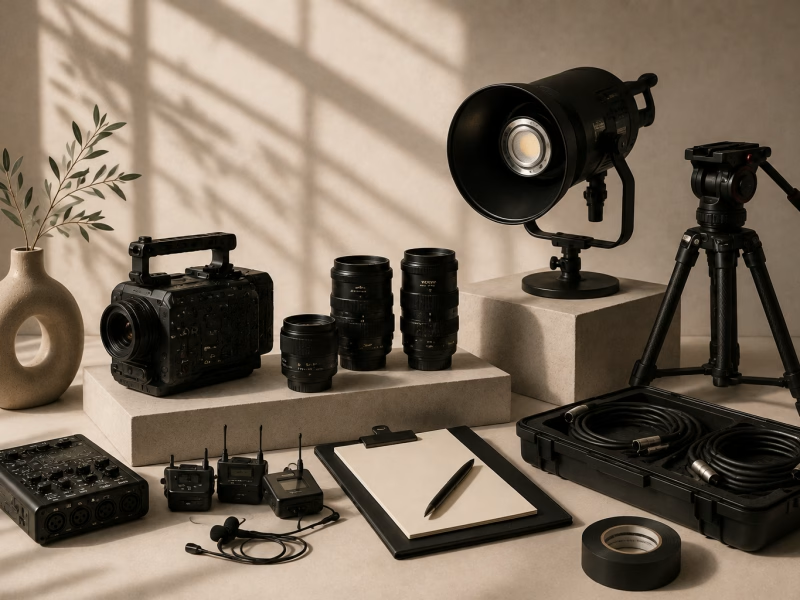
Small, quiet, and quick to set up, because the priority is the people rather than the picture. Kit choices are an ethical decision for a creative agency for charities, not only a technical one.
Large crews change behaviour and draw attention. A two-person team with compact kit gets more honest material and creates less disruption in a clinic, a classroom, or a community space.
- Audio first. Interviews carry these films. A wireless system with onboard recording means no lost interview if a connection drops, which matters when you cannot ask someone to repeat a difficult account.
- A compact body. Something like the Sony ZV-E1 handles low light in rooms you cannot relight, which is most of them.
- Light you can carry. A pocket fixture such as the Aputure MC Pro lifts a face without turning a room into a set.
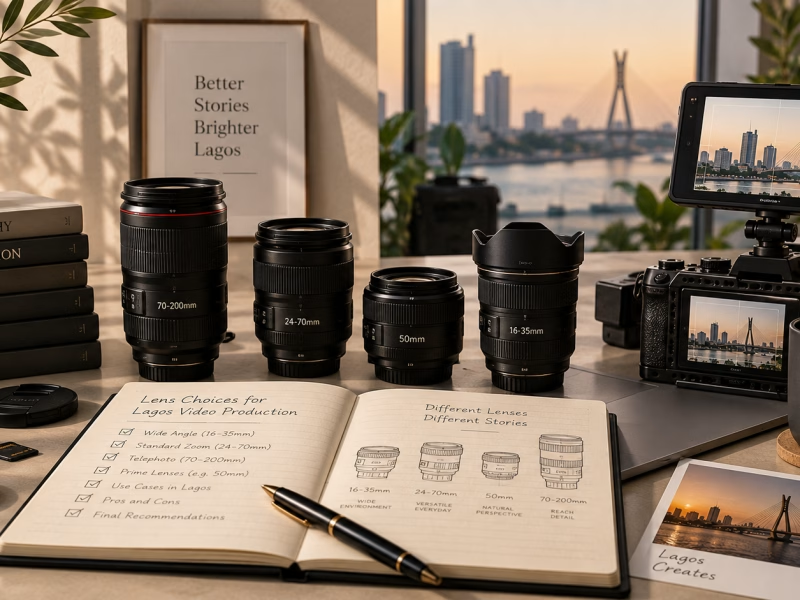
- A wide prime. A 16mm covers environmental context and lets you show setting rather than isolating a subject, which is exactly what the ethical codes ask for.
Event and conference work follows the same discipline. Our coverage of DevFest Lagos 2025 and the Untitled Designers Conference 2025 both ran on fixed single days with defined outputs, which is the same constraint a field trip imposes.
Data protection in Nigeria
Filmed identifiable people are personal data, and a creative agency for charities is a processor of it.
The Nigeria Data Protection Commission, established under the Nigeria Data Protection Act 2023, regulates the processing of personal data in Nigeria, and its guidance is clear that consent must be specifically requested rather than assumed from having informed someone. Section 29 of the Act requires that the methods by which data is collected align with the Act’s principles.
For a nonprofit shoot that means the consent conversation, the storage of footage, and the sharing of files with an agency all sit inside a data protection framework. Put the retention period and the deletion obligation in the contract with your agency. Most standard production agreements do not include either.
This is general information rather than legal advice, and an organization handling sensitive footage should take proper counsel on its own obligations.
Where this overlaps with other sectors
Some of the craft transfers into a creative agency for charities engagement. The ethics do not travel the other way.
A creative agency for social media running a nonprofit account faces the same platform mechanics as any other client, but every asset has passed through a consent check first. A creative agency for social media that treats a beneficiary portrait as stock will eventually publish something that has to be taken down.
Identity work behaves similarly. A creative agency for branding building a nonprofit identity has to design for donor trust and beneficiary dignity at once, which is a harder brief than most commercial work. A creative agency for branding that has only done consumer identities will default to warmth and lose the credibility half.
Other sector comparisons are more distant than they look. A creative agency for musicians can stage anything it wants, and a creative agency for musicians shooting a performance is under no obligation the nonprofit sector would recognize. A creative agency for ecommerce optimizes purely for conversion, and a creative agency for ecommerce brief applied to a fundraising appeal produces exactly the exploitative work the codes were written to prevent. A creative agency for hospitality works to accuracy rules on booking platforms, which is the closest commercial parallel, though a creative agency for hospitality is protecting a customer from disappointment rather than protecting a subject from harm.
Smaller organizations often behave like any other small client on everything except this. A creative agency for small business will recognize the budget constraints and the single decision-maker, but a creative agency for small business with no safeguarding experience is still the wrong hire for field work.
Location and crew
Field work happens where the programme is, which is rarely where the agency is.
Nonprofits operating outside Lagos need crew who can travel or partners on the ground. Searches for a creative agency in Abuja often come from exactly this, since so many Nigerian NGOs and international offices are based there.
Ask any creative agency in Abuja or elsewhere whether they staff the location or subcontract it, and whether travel and per diems are inside the quote. Both answers are workable. Discovering the arrangement after signing is not.
Red flags in a pitch
- No mention of consent anywhere in the proposal
- A portfolio of beneficiary close-ups with no context or names
- Staged imagery presented as documentary
- No safeguarding policy and no interest in yours
- A quote that omits travel on a brief that obviously requires it
- Reluctance to itemise, which will fail your funder’s audit
How we approach this work
We ask about consent and safeguarding before we ask about the creative, which is what we think a creative agency for charities owes an organization before it pitches.
That order matters, because the answers change what is shootable. If an organization has no consent process yet, that is the first piece of work, and we would rather build it with you than shoot around it.
If you have a grant-funded project and need quotes that will survive an audit, send us the brief and the reporting requirements together.
Frequently asked questions
Do we need signed consent from everyone in a wide shot?
Practice varies and your safeguarding policy governs. Identifiable individuals generally need consent. Crowds at a public event usually do not, though signage at entry is good practice.
Can we reuse footage from three years ago?
Only if the original consent covered ongoing use and the person has not withdrawn it. Consent obtained for one campaign does not automatically extend to the next.
Is it acceptable to pay participants?
Compensating people for their time is reasonable and common. Paying for a particular story is not, since it creates pressure to perform. Document whatever you do.
How do we brief a creative agency for charities work that has never done it before?
Send your safeguarding policy and the code you work to before the creative brief. If they engage with it seriously, that is a good sign. If they skip to the treatment, that is your answer.
Should the same film serve donors and the public?
No. Shoot once, cut twice. The obligations and the register are different enough that one edit will underserve both.
What if a subject asks to be removed after publication?
Honour it, and make sure your contract with the agency requires them to help. That is why file logging at the shoot matters.
Where to start
Before the creative brief, write down your consent process, your safeguarding contact, and what your funder requires you to report. Those three documents will shape the production more than any treatment, and any creative agency for charities worth hiring will ask for them unprompted.
Send them to us with your project dates and we will tell you what is shootable, what is not, and what it costs.