Google Ads Campaign Creation: Where Production Quality Actually Fits In
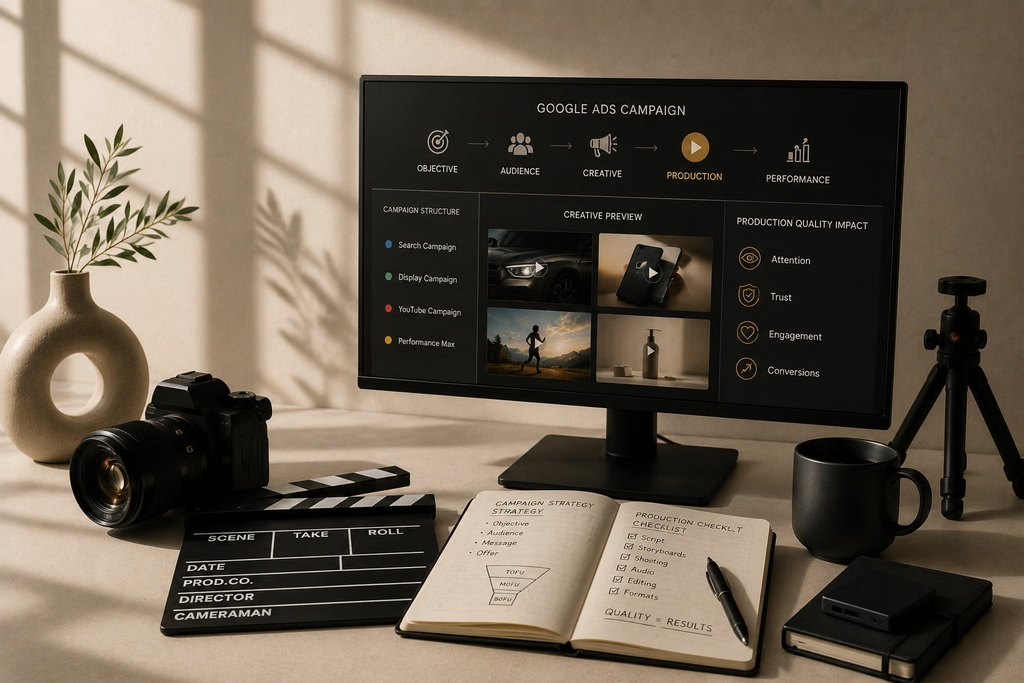
Most guides to Google Ads campaign creation stop at the interface. Pick an objective, set a budget, choose keywords, upload creative. The upload step gets one line, as though the file itself were incidental.
It is not incidental. The platform scores your creative, your landing page, and the match between them, and those scores decide what you pay per click.
Key takeaways
- Google’s own research puts video ads following its ABCD principles at up to a 30 percent lift in short-term sales likelihood.
- Landing page experience is one of three Quality Score components. A mismatched page raises your cost per click.
- Production quality is not the same as production budget. Framing, audio, and pacing matter more than camera choice.
- One shoot should produce assets for Google, YouTube, and ad campaigns on Facebook. Plan the aspect ratios before the shoot, not in the edit.
- The first five seconds carry the campaign. Everything else in Google Ads campaign creation is optimization.
- Report on creative, not only on spend, or you will keep buying the same underperforming asset.
What campaign creation actually asks you for
Google Ads campaign creation is four decisions and one file upload, and the file is the part most teams underprepare.
The four decisions are objective, campaign type, targeting, and budget. All four are reversible in an afternoon. The creative is not, because reshooting costs a day and a crew.
That asymmetry is the argument for treating assets as the first step in Google Ads campaign creation rather than the last.
Where production quality changes the numbers
Two scoring systems inside Google Ads campaign creation respond directly to how the work was made.
The first is creative effectiveness. Google’s guidance on the ABCDs of effective video ads sets out four principles: Attention, Branding, Connection, and Direction. Google and Kantar research cited alongside it reports up to a 30 percent lift in short-term sales likelihood and a 17 percent lift in long-term brand contribution for ads that follow them.
The second is Quality Score, which combines expected click-through rate, ad relevance, and landing page experience. Two of those three are downstream of what you produced.
Neither system rewards expensive production. Both reward clarity, and clarity is a set of decisions made on set.
That is the part worth internalizing before you start. Google Ads campaign creation does not measure your budget. It measures whether a stranger understood the ad and whether the page behind it delivered what the ad implied.
The asset list before you open Ads Manager
Build the list first, then shoot once.
| Asset | Ratio | Length | Where it runs |
|---|---|---|---|
| Hero video | 16:9 | 30s | YouTube in-stream, Display |
| Skippable cutdown | 16:9 | 15s | YouTube |
| Bumper | 16:9 | 6s | YouTube |
| Vertical | 9:16 | 15s | Shorts, Reels, Stories |
| Square | 1:1 | 15s | Feed placements |
| Stills | 1:1 and 4:5 | n/a | Display, feed |
Six line items from one shoot day, provided the shot list was built around versioning. Google Ads campaign creation goes quickly when this list already exists and slowly when it does not.
The counts matter as much as the ratios. Three concepts across those six line items is eighteen exports, and that number belongs in the production quote rather than in a discovery two days before launch.
The first five seconds decide the spend
Skippable formats mean Google Ads campaign creation is paying for attention you have to earn twice.
The opening frames do three jobs at once: hold the viewer, establish the brand, and signal what the ad is about. That is a production problem before it is a media problem.
What actually helps:
- Tight framing. Faces and products read on a phone screen. Wide establishing shots do not.
- Movement in frame one. Not a camera move, something happening.
- Brand visible early, in the frame rather than only in the endcard.
- Audio that works muted. Captions and on-screen text, since sound-off viewing is normal.
None of these cost money. All of them are decided before you roll.
Facebook and Google need different files from the same shoot
Plan cross-platform at the shot list stage, because reframing in post loses resolution and composition.
Searches for facebook ads campaign youtube split two ways. Some are people looking for video tutorials on running Meta campaigns. Others are teams trying to run one set of creative across both platforms. This section covers the second. If you want a facebook ads campaign youtube walkthrough instead, each platform’s own help center stays more current than any third-party video, because ad interfaces change several times a year.
Running ad campaigns on Facebook alongside search and video means delivering different ratios of the same idea. Meta’s aspect ratio guidance recommends different framing across feed, Stories, and Reels placements, and a 16:9 hero cropped to 9:16 usually loses the subject.
The practical fix is shooting with safe zones in mind: compose for 16:9 while keeping the subject inside a 9:16 center column. One take, two usable ratios.
A facebook ads campaign video and a YouTube pre-roll can share a hero cut, but the pacing differs. Feed video needs its point inside three seconds. Skippable YouTube gets five. A facebook ads campaign video built from a YouTube cut without re-editing the opening usually underperforms.
Teams running a facebook ads campaign, YouTube placements, and search together should also match export settings to each platform. YouTube’s upload encoding guidance recommends around 8 Mbps for 1080p at 30fps with AAC-LC audio at 48 kHz. Uploading a heavily compressed file and letting the platform re-encode it twice is a visible quality loss for no saving.
The ad campaign landing page
Every click bought through Google Ads campaign creation has to land somewhere that answers the question the ad asked.
The ad campaign landing page is the most common weak point in Google Ads campaign creation, because it usually belongs to a different team than the one buying media.
Four things to settle before launch:
- The headline echoes the ad’s promise in the same words
- One action on the page, not five
- Visual continuity, meaning the hero image or frame comes from the same shoot as the ad
- Load speed tested on mobile data, not office wifi
That third point is where production earns its place again. An ad campaign landing page using stock photography behind a video ad shot on location reads as a different company.
What changes on set when you are shooting for ads
Ad creative is shot for versioning, which changes the setup more than the gear list. Google Ads campaign creation assumes you have several cuts to test, and a shoot planned around one hero film cannot supply them.
Practical differences from a normal content shoot:
- Wider coverage of every beat, so the edit can crop to vertical
- More takes of the opening, because the first five seconds carry everything
- Product and brand elements framed centrally, away from platform UI overlays
- Clean audio, since captions get generated from it
A compact body like the Sony ZV-E10 covers this comfortably and shoots the vertical grabs on the same day. A fast wide such as the Sigma 16mm f1.4 gives the tight, close framing that reads on a phone. Controlled light from something like the Godox S100W keeps every version matching when you shoot six setups in a day.
For talking-head or testimonial ads, the RØDE Wireless GO II records two subjects on separate tracks, which matters because captions are only as good as the audio underneath them. A gimbal adds the motion that holds attention in frame one, and a backdrop stand lets you change looks between setups without changing location.
Reporting on creative, not just spend
An advertising campaign report that stops at cost per click cannot tell you what to shoot next. It reports the media buying and stays silent on the half of Google Ads campaign creation you actually control.
Platform reporting defaults to media metrics because those are what the platform controls. The creative question needs a separate cut.
| Look at | It tells you |
|---|---|
| View-through rate by asset | Which opening held attention |
| Cost per result by creative | Which idea converted, not which placement |
| Drop-off point in video | Where the edit loses people |
| Landing page bounce by source ad | Where the promise and the page diverge |
Build that into the advertising campaign report from the start. Creative-level breakdowns take longer to assemble than spend summaries, so ask for them before launch rather than after.
Briefing this out
If you are splitting Google Ads campaign creation from production, brief both against the same document.
An ad campaign proposal template is what an agency sends back, and comparing two of them fairly requires that both answered the same brief. Ask for the same headings: concept, shoot days, asset counts by ratio, post and versioning, and delivery specs per platform.
Advertising campaign execution is where split arrangements usually break. The media team assumes assets arrive in every ratio. The production team quoted for one hero film. Naming asset counts by ratio in the brief prevents that entirely, and any ad campaign proposal template you accept should list them explicitly.
Advertising campaign execution also covers versioning volume, which is the line most often underestimated. Six ratios of four concepts is 24 exports, not four.
How we approach ad creative at Mastermind CC
We build the asset list before the shot list, then shoot once. Assets built for Google Ads campaign creation are specified by ratio and count, never by vibe.
Event and brand work follows the same logic. Our production for the Builders Summit had a fixed day and a defined output set, which is the same constraint an ad shoot works under: one window, many deliverables, no reshoot.
If you already have the media plan and need the assets, we can quote against the ratio list rather than against a vague brief.
Frequently asked questions
Does higher production value improve Google Ads campaign creation results?
Clarity does. Expensive production does not automatically. Tight framing, legible text, clean audio, and a strong first five seconds outperform bigger budgets spent on scale.
Why do searches for “facebook ads campaign gig image” come up?
Those usually come from freelance marketplaces, where sellers need a thumbnail for a Facebook ads service listing. Searches for facebook ads campaign gig image point at marketplace thumbnail design rather than at campaign creative, so they are a different job from anything on this page. If you landed here looking for ad assets instead, the ratio table above is the relevant part.
Can I use the same video on Facebook and YouTube?
The hero cut can be shared, but re-edit the opening. Feed placements need the point inside about three seconds, and skippable YouTube formats give you a little longer.
How many creative variants should a campaign launch with?
Three to five distinct concepts, each in the ratios your placements need. Fewer than three gives the platform nothing to optimize between.
Should the landing page be built before the ads?
Yes. Writing ad copy against a page that does not exist yet produces a promise the page cannot keep, and that shows up in Quality Score.
Who owns the assets after the campaign?
Whatever the contract says. Agree it before the shoot, and name the raw files specifically rather than only the delivered exports.
How long should assets last before refreshing?
Watch frequency and view-through rate rather than the calendar. When the same audience has seen a cut several times, performance decays regardless of how recently it was made. Shooting extra setups on the original day is far cheaper than a refresh shoot two months later.
Where to start
Write the asset list before anything else. Ratios, lengths, and counts. That single table turns Google Ads campaign creation from a scramble into an upload, and it is the thing to send any production partner before asking for a price.
If you have the media plan and need assets built against it, send us the ratio list and we will come back with a shoot plan and a quote.