Lens Choices for Lagos Video Production: A Practical Breakdown
Lens advice online is written for people with unlimited rental houses and stable electricity. Neither applies here.
In Lagos you are usually working in rooms you cannot relight, in venues where the generator dictates the schedule, with kit that cost twice what the review said because it was imported. That changes which lenses are actually worth owning.
Key takeaways
- Sensor size decides your effective focal length. A 16mm on APS-C frames like a 24mm on full frame.
- Four focal lengths cover almost every job: wide, environmental, neutral, and portrait.
- Fast apertures matter more here than elsewhere, because you are frequently shooting in whatever light exists.
- Shooting vertical crops your frame horizontally, so you need wider than you think.
- Mixing lens brands costs you time in the grade, not just money at purchase.
- Rent an unfamiliar focal length before buying it. Two days answers more than any video production lens guide can.
Sensor size comes before focal length
Every number in this video production lens guide depends on what sensor is behind the glass.
Sony E-mount splits into two formats. APS-C bodies apply roughly a 1.5x crop, so the field of view narrows. Full-frame bodies do not.
Sigma’s 16mm F1.4 DC DN is the clearest illustration. It is designed for crop-sensor mirrorless, and on Sony E-mount APS-C it delivers a 24mm equivalent field of view at F1.4. Put a full-frame 24mm on an APS-C body and you get a 36mm equivalent instead, which is a different shot entirely.
This is the mistake that wastes the most money, and it is the reason any video production lens guide has to start with the sensor. Someone buys a full-frame wide for a crop body, discovers it is not wide, and buys again.
| Body format | Example | 16mm behaves like | 50mm behaves like |
|---|---|---|---|
| APS-C / Super 35 | Sony FX30 | 24mm | 75mm |
| Full frame | Sony FX3, A7 series | 16mm | 50mm |
Decide the body format first. The rest of this video production lens guide assumes you know which one you are on.
The four focal lengths that cover most work
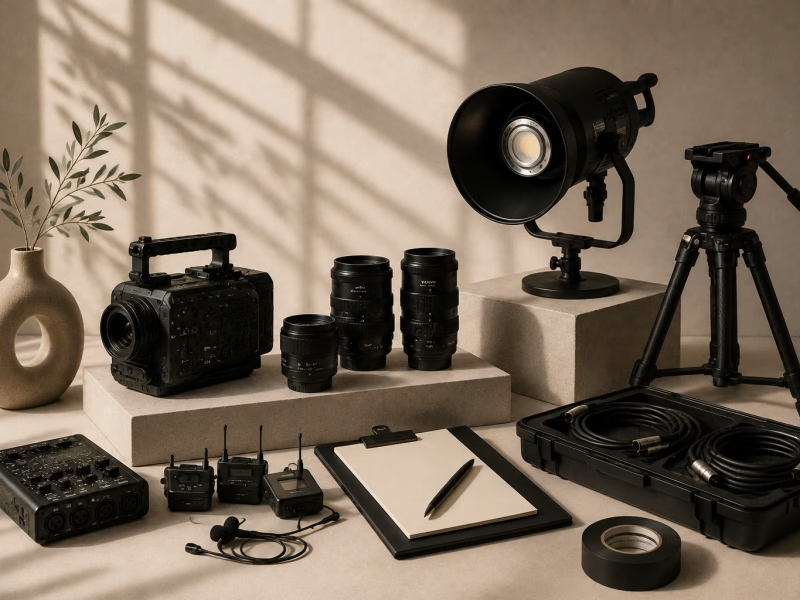
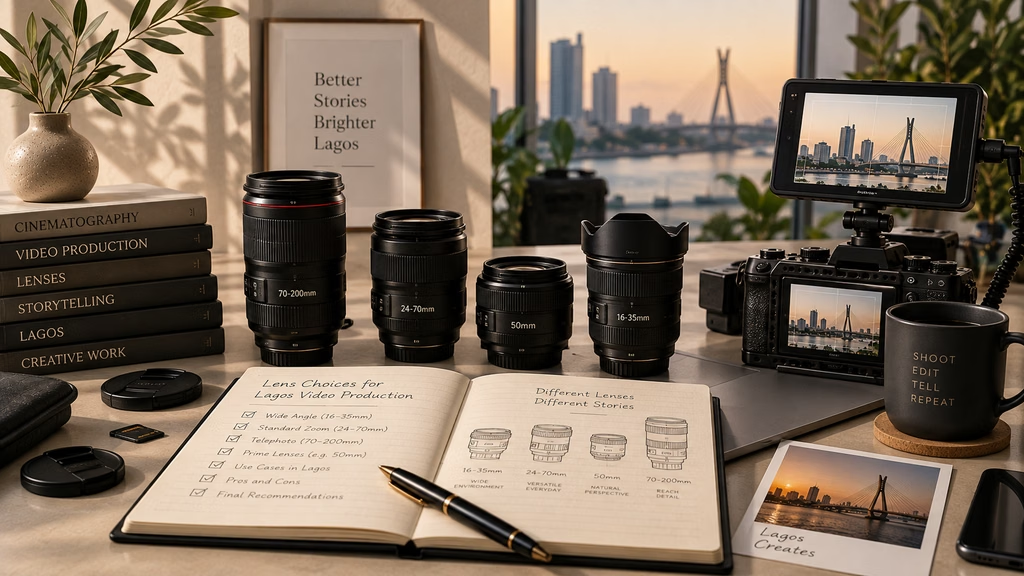
Most commercial video in Lagos is covered by four primes, and you rarely need more than two on a given day. Everything else in this video production lens guide is a variation on those four.
| Focal length (full frame) | What it does | Typical use |
|---|---|---|
| 16 to 24mm | Wide, shows the room | Interiors, events, establishing |
| 35mm | Environmental, subject in context | Documentary, walk-and-talk, b-roll |
| 50mm | Neutral, close to how we see | Interviews, product, general coverage |
| 85mm | Compressed, flattering | Portraits, testimonials, detail |
The Sigma 16mm covers the first row on a crop body. On full frame, a 35mm is the most useful single lens most people own, because it shows enough of the setting to explain where you are without distorting faces.
A 50mm is the interview default. An 85mm is what makes a talking head look expensive, because the compression separates the subject from a background you may not control.
One more note before the rest of this video production lens guide: two lenses per shoot day is the practical maximum for a small crew. Changing glass costs minutes you do not have when a venue has given you a two-hour window.
Primes or zooms
Primes for control, a zoom when you cannot move. This is the one question a video production lens guide cannot answer for you, because it depends on the room.
Primes are sharper, faster, cheaper at the same aperture, and lighter. The cost is that you move instead of twisting.
A zoom earns its place in three situations: fixed-position event coverage, anything where you cannot approach the subject, and multi-camera work where one operator cannot reposition mid-take.
For most branded content, interviews, and social video, primes win. For conferences, weddings, and stage work, a zoom on at least one body is the safer call.
What a fast aperture actually buys
F1.4 and F1.8 are load-bearing here in a way they are not in better-lit markets, which is why a Lagos video production lens guide weights aperture more heavily.
Two things happen when you open up. Less light is needed, and the background separates.
The first matters most in Lagos. Venues with unreliable power, interior offices with one window, evening events where the lighting was designed for atmosphere rather than cameras. A fast prime lets you shoot at a usable ISO instead of pushing the sensor into noise you will fight in post.
The separation is a secondary benefit, and it is overused. Shooting everything wide open produces footage where nothing is sharp and the focus puller had no chance. F2 to F2.8 is where most interview work should actually sit.
Vertical changes the answer
A 9:16 crop throws away most of your horizontal frame, so vertical work needs wider glass. Most published advice predates vertical delivery entirely.
If you shoot 16:9 and crop to vertical, you keep roughly a third of the width. A 50mm framing that looked correct horizontally becomes a tight head crop vertically.
Meta’s aspect ratio guidance recommends different framing across feed, Stories, and Reels placements, which in lens terms means either shooting wider than the horizontal composition needs or shooting the vertical separately.
The practical approach for a video production team delivering both: compose for 16:9 with the subject inside a central vertical safe zone, and go one focal length wider than you would for horizontal only. A 35mm instead of a 50mm, a 24mm instead of a 35mm.
Building the kit in order
A video shooting equipment kit assembles in a sequence, and lenses are not all bought at once. Treat this table as the buying order rather than a shopping list.
| Order | Lens | Why here |
|---|---|---|
| 1 | One fast prime near 35mm equivalent | Covers the widest range of jobs alone |
| 2 | A portrait length, 85mm equivalent | Interviews immediately look better |
| 3 | A wide, 24mm equivalent | Interiors and establishing shots |
| 4 | A zoom | Only once event work is regular |
Buy in that order and each lens does something the previous one could not. Buy in any other order and you will own two lenses that frame nearly the same shot.
A video shooting equipment kit also needs the unglamorous parts: filters, a lens cloth that lives in the bag, and caps you have not lost. Humidity in Lagos means glass needs checking before every shoot, not after.
The full lens range and the bodies they mount to are worth comparing side by side before committing, since mount compatibility rules out more options than budget does.
What this costs in Nigeria
Landed cost, not sticker price, is the number that matters, and it is where a Lagos video production lens guide departs from anything written abroad.
Lenses are imported and priced in dollars. The official rate is published daily by the Central Bank of Nigeria, and a quote costed two months ago may not hold.
That reality drives three sensible habits:
- Rent an unfamiliar focal length first. Two days tells you whether you will use it.
- Buy the second lens later. Most people over-buy at the start and under-use half of it.
- Treat used glass carefully. Manual lenses hold up well secondhand. Autofocus motors and stabilized elements are harder to verify.
Searches for a video camera cheap enough to start with usually surface older bodies with good sensors and poor codecs. Chasing a video camera cheap enough to leave budget for glass is the better version of that search. The better allocation is the opposite of what people expect: spend on the lens, economize on the body. A modest body with a fast prime beats an expensive body with a slow kit zoom, every time. That is the single most useful line in any video production lens guide.
Matching across a crew
Mixed glass costs you in the grade. No video production lens guide will tell you this because most are written for people who buy one lens at a time.
Different manufacturers render color differently. Two lenses from the same line cut together cleanly. A Sigma and a Sony in the same interview will need matching in post, and on a multi-camera shoot that becomes an hour per episode.
For a video production team shooting regularly, the rule is simple: match the lenses on any two cameras that will cut against each other. Different brands are fine on cameras that never appear in the same sequence.
This is also why a video production team should log which lens shot which card. Ten minutes of note-taking on the day saves a colorist guessing later.
Where photo and video diverge
Photo equipment mostly works for video, with three exceptions worth knowing before you shoot.
A lens bought as photo equipment will usually mount and shoot fine. What catches people out:
- Focus breathing. The frame shifts slightly when focus pulls. Invisible in stills, obvious in video.
- Aperture stepping. Some lenses adjust in visible clicks rather than smoothly.
- Noisy motors. Autofocus audible on the camera mic, which matters when the mic is close.
None of these rule out using photo equipment for video. They just mean testing before a paid shoot rather than discovering it in the edit.
Common mistakes
- Buying a full-frame wide for a crop body. The most expensive misunderstanding in this list.
- Shooting everything wide open. Nothing is sharp and focus becomes a coin flip.
- Owning three lenses that frame the same shot. Check the equivalent focal lengths before buying, not the printed numbers.
- Ignoring delivery resolution. YouTube’s guidance recommends around 8 Mbps for 1080p at 30fps, and plenty of client work never exceeds 1080p, which changes how much cropping room you actually need.
- Skipping the humidity check. Fungus in glass is permanent and common here.
How we choose lenses per job
We pick focal lengths from the shot list, not from what is in the case. That is the working version of this video production lens guide.
For interview-led work, a 50mm and an 85mm equivalent cover almost everything. For event coverage, a wide and a zoom. For branded content shot for both horizontal and vertical, everything moves one step wider.
Our video production services include the lens decisions as part of the plan rather than as an afterthought, because focal length determines how much space we need in a venue, and venue access is usually the constraint that decides the day.
If you are booking video production services and the quote does not say which focal lengths are coming, ask. It tells you whether anyone has thought about the location.
Frequently asked questions
What does a video production lens guide say to buy first?
A fast prime around 35mm equivalent. It handles interviews, b-roll, and environmental shots, and it will still be useful after you own four others.
Do I need different lenses for different video camera types?
Mount and sensor format matter, not the category. Video camera types range from compact mirrorless to cinema bodies, but a full-frame E-mount lens behaves the same on any full-frame E-mount body. Check the mount and the format, then ignore the marketing category.
Is a video camera digital sensor different from a photo one?
Not fundamentally. A video camera digital sensor is optimized for continuous readout and heat management rather than for single-frame resolution, which affects rolling shutter and recording limits more than it affects which lens you should choose.
How do I find video production companies near me with the right kit?
Ask what they shoot on before you ask for a price. Searches for video production companies near me return everyone; asking about bodies, mounts, and focal lengths narrows it in one message.
Should I buy or rent lenses?
Buy the one or two you use weekly. Rent anything specialised, and rent anything you have not used before making the decision.
Does image stabilization matter for video?
It helps handheld work and matters less on a gimbal or tripod. If you shoot handheld often, prioritize it. If you work off sticks, spend the money on aperture instead.
Working out your own list
Write down the last ten things you shot and the framing each one needed. Most people find two focal lengths covered eight of them, which is a more honest video production lens guide than any list of recommendations.
Buy those two properly, rent the rest for a while, and revisit the list in six months. Kit needs change with format, and a video production lens guide written for your last project will not fit your next one. If you want a second opinion before spending, send us the shot types you handle most and we will tell you what we would carry.