Podcast Production Agreements: What Should Actually Be in Writing
Most podcast disputes are not about money. They are about who owns the raw files, who approves the final cut, and whether the sponsor read counts as one deliverable or three. All of that is cheap to settle in a document and expensive to settle afterward.
A podcast production agreement is not a formality you sign once and file. It is the reference you open in month seven, when the host wants to move platforms and the producer still holds the multitrack sessions.
This article covers what belongs in the document and why. It is not legal advice, and nothing here replaces a lawyer reviewing your specific contract in your specific jurisdiction.
Key takeaways
- Ownership of the recording does not follow whoever paid. It follows whatever the contract says, and silence usually favors the person who pressed record.
- Under Nigeria’s Copyright Act 2022, sound recordings and audiovisual works are protected, and transfers need to be documented rather than assumed.
- Scope disputes almost always trace back to an undefined word: episode, revision, delivery, approval.
- Gear belongs in a schedule with serial numbers, not in a sentence that says the producer will bring equipment.
- Sponsorship clauses are regulatory documents in disguise. Nigerian ads need ARCON clearance, US audiences trigger FTC disclosure rules.
- A kill fee protects both sides. Without one, a cancelled shoot becomes an argument instead of an invoice line.
- Every clause below can sit in a two-page podcast production agreement. Length is not what makes a contract work.
Why a handshake stops working around episode six
Verbal arrangements survive until the first thing goes wrong, and something always goes wrong by episode six.
The early episodes hide the problem. Everyone is excited, nobody is arguing, and the work is small enough that goodwill covers the gaps. Then one of these happens:
- A guest asks for their episode to be removed after publication
- A sponsor signs, and suddenly there is revenue to divide
- The host wants the raw files to hire a different editor
- One party wants to stop, and the other has already booked a studio
Each of those is a two-line clause in a podcast production agreement and a two-week argument without one.
The nine clauses that belong in every podcast production agreement
Nine clauses cover almost every dispute that reaches a lawyer, and a podcast production agreement missing any of them has a predictable weak point.
| Clause | The question it answers | What goes wrong without it |
|---|---|---|
| Parties and term | Who is bound, and for how long | Nobody knows when the arrangement ended |
| Scope and deliverables | What counts as one finished episode | Endless revisions billed to nobody |
| Ownership and license | Who holds copyright in the recording | Files held hostage during a fallout |
| Payment and schedule | Amounts, milestones, late terms | Invoices chased for months |
| Equipment schedule | Whose gear, who insures it | Damage disputes with no baseline |
| Approvals and revisions | Who signs off, how many rounds | Approval by committee, forever |
| Sponsorship and advertising | Who sells, who complies, who is paid | Regulatory exposure lands on the wrong party |
| Confidentiality and guest releases | What can be published and reused | Takedown demands after publication |
| Termination and kill fee | How it ends and what is owed | Cancelled shoots with unpaid crew |
Everything after this section unpacks the four that cause the most damage.
Who owns the recording
Ownership is the single clause in a podcast production agreement worth paying a lawyer to review.
Copyright in a podcast is not one right. It sits across several layers: the sound recording, any audiovisual fixation, the script, the music, and the performances of everyone at the table.
Nigeria’s Copyright Act 2022, administered by the Nigerian Copyright Commission, protects sound recordings and audiovisual works and sets out separate performers’ rights. Registration is optional, but the Commission notes that certain statutory presumptions apply only to registered works, which matters if you ever need to prove ownership in a dispute.
Producers working with US clients meet a different concept. The US Copyright Office explains that a commissioned work only counts as a work made for hire when both parties expressly agree in a signed writing and the work falls within one of nine listed categories. An email saying “we own everything you make” does not achieve that.
Three drafting choices you actually have:
- Full assignment. The client owns everything on delivery. Common for brand shows.
- License. The producer keeps copyright, the client gets defined publishing rights. Common for co-produced shows.
- Split by layer. The client owns the episode, the producer keeps portfolio and showreel rights.
Whichever you choose, name the raw multitrack files explicitly. Most agreements transfer the finished episode and stay silent on the sessions, which is exactly the file people fight over.
Scope: the clause that prevents most disputes
Define every word that could be read two ways, then define what is excluded.
“One episode” means nothing on its own. A workable scope clause specifies runtime range, number of recording hours, number of revision rounds, delivery format, and turnaround.
Exclusions matter as much as inclusions. Write down what is not covered:
- Additional cameras beyond the number stated
- Guest travel and location fees
- Music licensing
- Clips, shorts, and social cutdowns
- Transcripts and show notes
- Re-records caused by a technical fault on the client side
A podcast production agreement that lists ten exclusions will trigger fewer awkward conversations than one that lists none, because every exclusion is a conversation you have before the invoice rather than after it.
The equipment schedule
Attach a gear list with serial numbers to the podcast production agreement, then say who insures it and who pays for damage.
“The producer will supply professional equipment” is an argument waiting to happen. A schedule ends it.
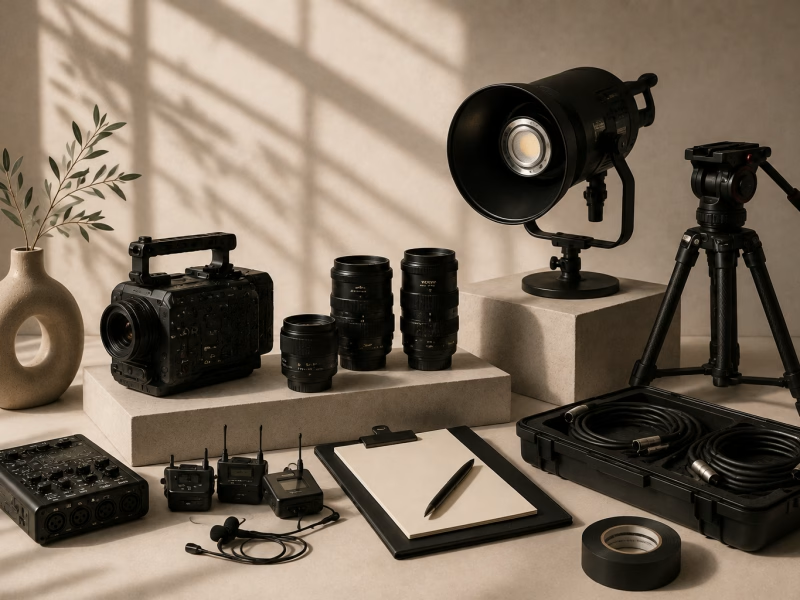
A usable equipment schedule names each item, its owner, its replacement value, and the party carrying insurance during the booking. Something like a DJI RS 5 gimbal or a Sony FX3 cinema camera should appear as a line item, not as a general reference to camera support.
The same applies to the smaller things that go missing on set. Stands, backdrops, and clamps from a grip package rarely get counted at wrap unless somebody signed for them. Microphones, cables, and interfaces from the audio package are worse, because a lost adapter stops a shoot in a way a lost sandbag does not.
Where gear is rented rather than owned, say so and attach the rental terms. Shows that rent production gear by the day should make sure the rental liability and the production agreement point at the same party, because rental companies pursue whoever signed their form regardless of what your production contract says.
Sponsorship and advertising clauses
The moment a sponsor appears, your podcast production agreement becomes an advertising contract too.
Split the clause into four questions:
1. Who sells? Host, producer, agency, or network.
2. Who is paid, and in what split? State it as a percentage with a worked example.
3. Who produces the creative? A host-read spot is different work from a produced ad.
4. Who carries compliance risk? This is the one people skip.
Compliance is where Nigerian and international shows diverge. The Advertising Regulatory Council of Nigeria, operating under the ARCON Act No. 23 of 2022, requires pre-exposure vetting of advertising and marketing communications, and that mandate now extends to digital and influencer content. If your show carries a paid spot aimed at Nigerian listeners, somebody has to own that clearance, and the contract should name them.
Shows reaching US audiences face a separate obligation. The FTC’s Endorsement Guides, revised in 2023, require material connections between an endorser and a brand to be disclosed clearly and conspicuously, and the FTC has said a platform’s built-in disclosure tool may not be enough on its own.
Where the engagement extends past a single spot into full advertising campaign services, the agreement needs its own scope. Advertising campaign management covers media planning, flighting, reporting, and creative revisions, and none of that is implied by a podcast production contract. Treat it as a separate schedule or a separate document.
Every paid campaign should also attach an advertising campaign brief. A useful advertising campaign brief states the objective, the audience, the single message, the mandatory claims, the prohibited claims, and the approval chain. The strongest advertising campaign brief example we have seen ran to one page and named a single approver, which saved more time than any ten-page version nobody reads. Ask your agency for an advertising campaign brief example before you commission the campaign, not after.
Payment, kill fees, and cancelled episodes
Say what happens when the work stops, because that is when a podcast production agreement earns its keep.
Payment terms need four elements: amount, trigger, deadline, and consequence. “Net 30” without a late-payment consequence is a suggestion.
| Situation | What the contract should say |
|---|---|
| Client cancels more than 7 days out | Deposit retained, no further fee |
| Client cancels inside 48 hours | Full day rate, crew already committed |
| Guest no-show | Session billed, reschedule at cost |
| Producer cancels | Deposit returned, replacement crew at producer’s cost |
| Episode never publishes | Production fee still due on delivery, not on publication |
That last row causes more disputes than the rest combined. Producers are paid to deliver an episode, not to guarantee that a client publishes it, and the contract should separate the two events plainly.
Who you are contracting with changes the agreement
The same nine clauses get weighted differently depending on who is on the other side of the podcast production agreement.
| Counterparty | Weight the clauses here | Common gap |
|---|---|---|
| Full-service agency | Scope, approvals, IP assignment | Portfolio rights never negotiated |
| Solo editor on a podcast production freelance basis | Deliverables, turnaround, file handover | No successor clause if they stop |
| Part-time assistant | Confidentiality, access, offboarding | Platform passwords never revoked |
| In-house hire | Employment terms, IP by default | Contractor treated as employee |
Coaches and consultants sit in a category of their own. A podcast production company for coaches is usually also handling lead capture, episode-to-offer mapping, and repurposing into email, which means the agreement should cover marketing deliverables rather than only audio ones. If you are hiring a podcast production company for coaches and the contract only mentions editing, the scope is already wrong.
Podcast production freelance arrangements need a file-handover clause more than anything else, because a freelancer who stops replying takes your project files with them unless the contract required a shared drive from day one.
Teams hiring a podcast production virtual assistant part time should treat access as the main risk. A podcast production virtual assistant part time will hold logins to your host, your scheduler, and often your email, so the agreement needs a named offboarding process with a deadline for revoking each one.
Where a podcast production agreement template helps
A podcast production agreement template is a checklist, not a contract.
Templates are useful for making sure you did not forget the equipment schedule or the kill fee. They fail in three predictable ways:
- Jurisdiction. A template drafted for US clients will reference statutes that do not apply in Nigeria, and vice versa.
- Payment reality. Templates assume one currency and one banking system.
- The specific deal. No template knows that your client wants approval over guest selection.
Use a template to build the outline, then have a lawyer adapt it once. The second and third contracts cost far less than the first.
How we structure this at Mastermind CC
We put scope, ownership, and the gear schedule in writing before the first shoot day, on every project.
Long-running series make the reason obvious. Our work on Overnight Success for Culture Custodian ran across 2022 to 2024, which is long enough for team members to change, formats to evolve, and sponsors to come and go. Agreements that hold up over that span are specific about deliverables per episode and explicit about who owns what at the end.
For video-led shows we attach the camera package as a named schedule rather than a description, so replacement values are agreed before anything is on a truck.
Red flags in a contract someone hands you
- Silence on raw files. If the sessions are not mentioned, assume you are not getting them.
- Unlimited revisions. Generous on paper, unworkable in practice, and it delays every payment trigger.
- Automatic renewal with a short notice window. Diarize the notice date the day you sign.
- Broad exclusivity. Check whether it stops you working with anyone in a whole category.
- Payment on publication. Ties your fee to a decision you do not control.
- No governing law clause. Cross-border work without one turns a small dispute into a jurisdictional one.
- Definitions that appear only once. If a podcast production agreement uses a defined term in one clause and plain language everywhere else, the definition probably does not do what you think.
Getting the document in place
Start with the nine clauses in the table above, draft the scope and ownership sections of your podcast production agreement yourself in plain language, and give that draft to a lawyer to review rather than asking them to start from nothing. Reviewing a clear draft costs a fraction of drafting one from scratch.
If you would like to see how we structure scope, deliverables, and gear schedules on a running series, send us your format and we will walk you through ours.
Frequently asked questions
Do I need a podcast production agreement for a single episode?
Yes, though it can be short. A one-page document covering scope, fee, ownership, and cancellation is enough for a pilot and takes minutes to produce.
Who owns a podcast by default if nothing is written down?
It depends on jurisdiction and on who created what. In practice, whoever holds the recordings has the stronger negotiating position regardless of the legal answer, which is why the ownership clause matters more than the default rule.
Can I use a free podcast production agreement template?
As a starting outline, yes. Have a lawyer adapt it to your jurisdiction before you sign anything with real money attached, because template clauses often reference laws that do not apply where you operate.
Should the sponsorship clause sit in the same document?
Only for simple host-read spots. Anything approaching full advertising campaign services deserves its own agreement, since advertising campaign management brings reporting obligations and approval chains that a production contract does not anticipate.
What is a kill fee and what is a fair one?
A kill fee is the amount owed when work is cancelled after it has been committed but before delivery. Fair depends on how much was already spent. Tie it to notice period and to crew already booked rather than to a flat percentage.
Do guest release forms need to be in the main agreement?
No, but the agreement should say who collects them, when, and what happens if a guest later withdraws consent. Keep the releases themselves as a separate signed document per guest.
What if the client wants changes after the episode is published?
Define post-publication edits as a separate paid service. They usually involve re-uploading, updating show notes, and sometimes re-cutting a sponsor read, and none of that fits inside a standard delivery.