Podcast Production Teams and Roles: Who Actually Does What
A podcast production team can be two people or twelve. Format decides the number, not ambition. A weekly audio interview ships fine with a producer and an editor. A four camera video show with a live audience needs camera operators, a gaffer, a sound recordist, and somebody chasing signed release forms before anyone sits down.
Most shows overstaff the seats that feel important and understaff the ones that break first. Below is every role, what it owns, what it costs, and the point in a show’s life when you actually need it.
Key takeaways
- The producer owns the show. The editor owns the file. Merging those two jobs is the most common staffing error in podcasting.
- Two people can run a weekly audio interview show. Adding cameras roughly doubles the crew and triples post time.
- The US Bureau of Labor Statistics puts median pay for producers and directors at $83,480 a year as of May 2024, with the top 10 percent above $198,530. That spread explains why quotes for the same brief differ by four times.
- A coordinator is the cheapest seat and prevents the most expensive problems: no-show guests, unsigned releases, missing cards.
- Audience is no longer the constraint. Publishing on schedule is, and that is a staffing question before it is a creative one.
- Hire in this order: producer, editor, engineer, coordinator, camera. Building a podcast production team in reverse is why shows stall around episode eight.
What a podcast production team actually does
Every podcast production team covers four jobs: booking, capture, post, and release. Roles are bundles of those four. Small teams bundle them into two people. Networks split them across ten.
The bundling is where shows fail. A host who books guests, runs the board, cuts the file, and writes the show notes will miss a week by month three. Nobody fails that test on willpower. They fail it on hours.
Three shapes cover almost every setup:
- Host plus editor. The host books and records, then hands off a raw file. The editor cuts, mixes, and uploads. Fine for weekly audio interviews under an hour.
- Shared agency pod. One producer, one engineer, one editor, and one coordinator work across three or four shows at once. Cost per episode drops because the studio, the desk, and the crew are shared.
- Dedicated in-house team. A producer per show, with engineering and marketing shared across the slate. Networks run it this way.
The eight core podcast production roles
Eight podcast production roles cover almost every show, and no show needs all eight at once. Most working podcast production teams run four or five of them.
| Role | What it owns | When it starts mattering | Safe to skip when |
|---|---|---|---|
| Executive producer | Budget, format, talent, sponsor relationships | Before episode one | The host is also the owner |
| Producer | Episode plan, guest brief, run of show, final cut approval | Episode one | Never |
| Podcast production coordinator | Scheduling, releases, file handoff, publish checklist | Around episode ten | You publish twice a month or less |
| Audio engineer | Mic placement, gain, room, mix, master | Episode one | Your desk auto-mixes one treated room |
| Editor | Cuts, pacing, music, cleanup | Episode one | Never |
| Camera operator | Framing, focus, card management | Your first video episode | Audio only |
| Gaffer | Key, fill, background, look consistency | Your first video episode | Audio only |
| Clips editor | Shorts, thumbnails, show notes, posting | Episode one | You have no distribution target |
Three pairs of these roles get confused constantly.
Producer versus executive producer
The producer runs episodes. The executive producer runs the show as a business.
On a two person team the host usually holds both. That holds up until a sponsor arrives, then the jobs pull in opposite directions. One wants a better episode. The other wants a renewed contract. Someone has to decide which wins when the guest is boring but the sponsor loves them.
The Bureau of Labor Statistics groups both titles under producers and directors, an occupation covering about 167,000 US jobs with a projected 5 percent growth through 2034.
Audio engineer versus editor
The engineer protects the recording. The editor rescues the story.
Engineers work before and during. Editors work after. Merge them and the person who set the gain is the same person who has to live with it, which matters because clipped audio does not come back. You can fix pacing in post. You cannot fix a distorted transient.
On a single room show with a desk that mixes automatically, one competent operator covers both. Add a second room, a remote guest, or a live audience and the jobs separate again.
Podcast production coordinator versus producer
The coordinator keeps episodes from dying between steps.
The producer decides what happens. The coordinator makes sure it happens on the right day with the right paperwork. On paper it looks like admin. In practice it is the seat that saves the most money.
What the role carries week to week:
- Confirms every guest twice, at booking and again 24 hours out
- Collects signed releases before anyone is on camera
- Names, transfers, and backs up every card and audio file the same way each time
- Runs the publish checklist covering artwork, chapters, transcript, notes, and links
- Tracks which sponsor read belongs in which episode
One no-show guest costs a studio day. One lost card costs an episode. A part time coordinator costs less than either.
How many people you actually need
Size a podcast production team by capture points, not by budget. Count the microphones, the cameras, and the rooms. Staff one operator for every two capture points, plus one editor per weekly episode.
| Show format | Crew on the day | Post crew | Weekly hours we plan against |
|---|---|---|---|
| Audio interview, one room | Host, engineer | One editor | 8 to 12 |
| Audio interview, remote guests | Host, producer | One editor | 6 to 10 |
| Two camera video podcast | Host, camera operator, engineer | Editor, clips editor | 20 to 30 |
| Four camera video, live audience | Host, two camera operators, engineer, gaffer, coordinator | Editor, clips editor, colorist | 40 and up |
Those hour ranges come from our own scheduling at Mastermind CC rather than an industry survey. Treat them as planning figures and adjust once you have three episodes of real data.
Video is the reason the bottom two rows look so different. A camera adds framing, focus, card offload, color, and sync. Each of those is somebody’s job for part of the week.
Podcast producer rates and what a team costs
Producer pricing arrives in three shapes: per episode, monthly retainer, or salary.
The BLS wage spread explains most of the confusion. The bottom 10 percent of producers and directors earned under $43,060 a year in May 2024. The top 10 percent earned more than $198,530. Two people can both accurately call themselves producers and be four times apart on price.
Five things move the number:
- Format. Video costs more than audio, without exception.
- Volume. A 24 episode commitment prices lower per episode than a run of four.
- Scope. Booking, scripting, and sponsor chasing each add a line.
- Turnaround. Delivery in 48 hours costs more than delivery in seven days.
- Market. Rates in Lagos, London, and New York are not comparable, and neither are the currencies they are quoted in.
| Engagement model | Fits | What you get | The risk |
|---|---|---|---|
| Per episode freelance | Under two episodes a month | Editing and mix, sometimes booking | Nobody owns the calendar between episodes |
| Monthly retainer | Weekly shows | Producer, editor, coordinator | Quiet months still bill |
| Agency | Brand shows and video formats | Full crew, gear, studio, one contract | Less day to day control of the process |
| In-house hire | Three or more shows | Dedicated attention, deep format knowledge | Salary plus gear plus studio before episode one |
Ask any quote to separate crew time from gear and studio time. Quotes that bundle everything into one number are impossible to compare, and they hide whether you are paying for people or for equipment you could rent for a day.
The podcast production desk is a staffing decision
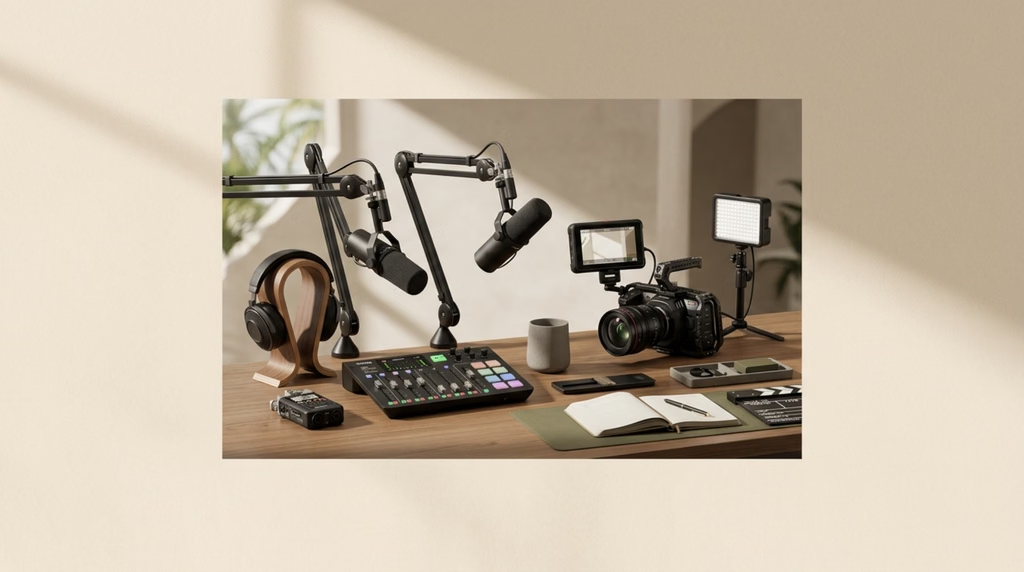
A podcast production desk sets the minimum size of your podcast production team.
Four microphones need four headphone feeds, four gain controls, and four mute buttons within reach. If one operator cannot reach all of them, you have just hired a second operator.
What the layout has to solve:
- Channel count. The RØDECaster Pro II handles four mic inputs with individual headphone levels and multitrack recording, so a single engineer can run a four seat table.
- Mic rejection. Dynamic mics such as the RØDE PodMic USB reject room reflections, which matters more than mic quality in an untreated space.
- Reach. Boom arms need a clampable desk edge. Stands need roughly 60cm of usable depth per seat.
- Cable routing. Headphone cables crossing the table are the most common cause of a knocked microphone mid take.
Guests notice sound before they notice anything else, so this is worth solving before you spend on cameras. Our full podcast audio kit covers mics, interfaces, stands, and monitoring for setups from one seat to four.
In-house teams, agencies, and podcast production networks
Agencies sell production. Podcast production networks sell distribution and ad sales. In-house teams sell control.
| In-house team | Agency | Network | |
|---|---|---|---|
| You control | Everything | Format, guests, approvals | Content only |
| They control | Nothing | Crew, gear, schedule | Distribution, ad sales, often format |
| You pay | Salaries, gear, studio | Fee per episode or per month | Revenue share |
| Best fit | Three or more shows running | Brand shows, video formats, launches | Shows with proven listener numbers |
Networks buy audiences rather than ideas. Edison Research put monthly podcast consumption at 58 percent of Americans age 12 and over in 2026, an estimated 167 million people, so the listeners exist and networks know it. Approach one after 20 episodes and a stable download curve, not before. The money behind that interest is real. IAB and PwC recorded $2.9 billion in US podcast ad revenue for 2025, growing 17.6 percent year over year, faster than the internet ad market as a whole.
Video changed what networks are shopping for. IAB flagged that its own podcast definition now lags the market because video has become the leading consumption channel. A show that can only deliver audio is competing for a shrinking slice.
How we build a podcast production team at Mastermind CC
We start with the smallest crew that can ship on schedule, then add seats when the format demands them.
For an audio show, that base is a producer, an engineer, and an editor. For video, we add a camera operator and a gaffer on shoot days and a clips editor in post. The coordinator joins around episode ten, when the calendar starts carrying more than the host can hold.
Multi camera work is where the difference shows. Our crew handled TEDxLagos 2024 with live audio capture, multiple camera positions, and a stage lighting setup that had to stay consistent across a full day of speakers. The same discipline applies to a video podcast: consistent framing, consistent color, consistent levels across every episode.
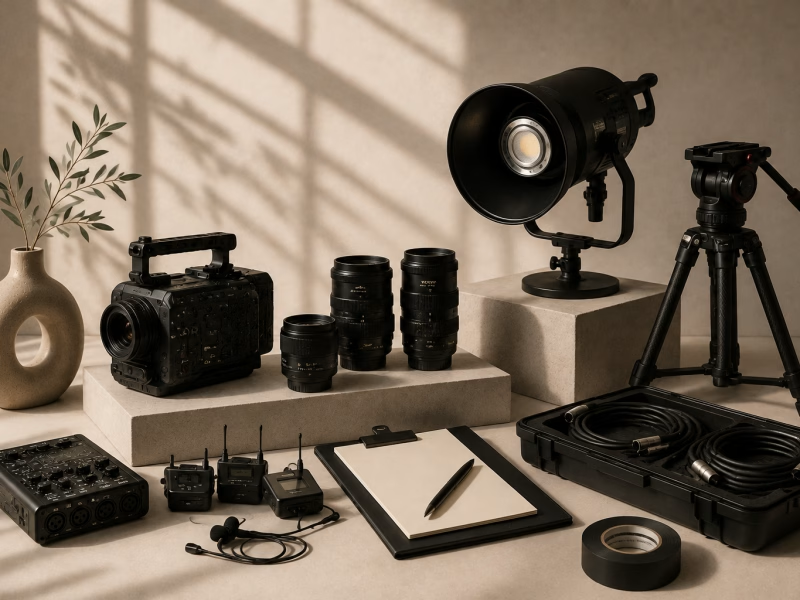
Shows that already have crew but no kit can rent gear by the day instead of buying. That covers cinema and mirrorless bodies for multi camera setups and studio lighting for keeping a set looking the same in episode 40 as it did in episode one. Renting also lets you test a two camera format before committing a budget to it.
Staffing mistakes that cost episodes
Most of these are podcast production team gaps rather than talent gaps. Each one costs published episodes, and each one is cheap to fix before it happens.
- Hiring an editor before a producer. You get well cut episodes of a show with no direction, published whenever the host remembers.
- Making the host the coordinator. Hosts should walk in prepared, not carrying the schedule and the paperwork.
- One person on cameras and audio. The moment a card fills mid interview, one of those two jobs stops happening.
- Nobody named for publishing. Episodes sit finished in a folder for days because publishing belonged to everyone.
- Booking a studio before booking crew. Studio days are the least flexible thing in the calendar and the easiest to waste.
- Adding video without adding post. Shooting is the cheap part. A two camera edit takes roughly twice as long as an audio cut of the same length.
Sizing your own team
Sizing a podcast production team starts with capture points, not budget. One room, one camera, one mic per seat gives you the number of hands you need on the day, and one editor per weekly episode gives you the number you need after it.
If you already know your format and want a call sheet built around it, send us the show details. We will tell you which seats you need on day one and which ones can wait until episode ten
Frequently asked questions
How big should a podcast production team be for a weekly audio show?
Two to three people. A producer who books and shapes episodes, an editor who cuts and mixes, and a host. Add a coordinator once you pass roughly ten episodes or start juggling more than two guests a month.
What is the 450 Podcast Production Team event in BPA?
Business Professionals of America runs a competitive event numbered 450, in which teams of two to four students produce a three to five minute podcast on a set topic. The event sits in BPA’s digital communication and design category. Official 450 Podcast Production Team guidelines are published through the BPA member gateway.
What does podcast production team BPA refer to?
Searches for podcast production team BPA almost always come from students or advisors looking for that competition, not from people hiring a crew. If you landed here looking for the competitive event, the BPA member gateway link above is the source to use.
Who is the podcast production coordinator Zoe that people search for?
Searches for podcast production coordinator Zoe point at a specific person rather than a job standard. Coordinators build personal reputations and get referred by first name, which is why those searches exist. If you are hiring, search the role plus your city. If you are trying to reach one particular coordinator, credits in a show’s episode notes and LinkedIn will find them faster than a general search.
What do podcast producer rates usually include?
At minimum, episode planning and post supervision. Booking, scripting, sponsor coordination, and clip production are usually priced separately. Ask for the scope in writing before comparing two quotes, because a quote covering four tasks and a quote covering one look identical on an invoice.
Can one person be the whole team?
For a while. Solo operators publish successfully, usually by keeping the format simple: one room, one mic, minimal editing. The failure point is guest scheduling. Once external calendars enter the process, the admin load grows faster than the creative load.
Do podcast production networks provide the crew?
Rarely. Most networks handle hosting, distribution, and ad sales, then expect you to arrive with a finished file. Production stays your problem, which is why plenty of network shows also work with an agency.
What belongs on a podcast production desk?
A mixer or interface with one channel per seat, a dynamic microphone and boom arm per seat, closed back headphones for everyone at the table, and a monitoring path for whoever is running sound. Everything else is optional until the room and the recording chain are solid.
.