Video Production Services: What’s Actually Included at Each Tier
Video production services get quoted at wildly different prices for what sounds like the same job, and the reason almost always comes down to what tier the quote is actually describing. Entry, standard, and premium packages differ in crew size, camera type, turnaround time, and what happens to the raw footage after the shoot, not just in price. This breakdown covers exactly what each tier of video production services includes, so a quote can be judged on what it actually delivers, not just the number at the bottom. Understanding this before requesting quotes is what separates an informed buyer from someone comparing video production services on price alone.
- Entry tier: one operator, one camera, minimal post production, fastest turnaround.
- Standard tier: a small crew, multiple cameras, structured editing and revisions.
- Premium tier: full crew, specialty gear like FPV drones, color grading, and extended post.
- The real question: not which tier is best, but which tier actually matches the deliverable needed.
What Do Video Production Services Actually Include?
Video production services span a wider range of deliverables than most first time clients expect, from a single operator with one camera to a full crew running multiple setups at once. The tier a project actually needs depends on the deliverable, not on what sounds most impressive in a proposal.
The Three Layers Every Tier Builds On
Every tier of video production services is built from the same three layers: capture, coordination, and post production. What changes between tiers is how much of each layer gets included, and how many people it takes to deliver it. A single operator handling all three layers alone looks very different from a coordinated crew splitting them across specialists.
Even a top tier package still starts with the same basic question every smaller job asks. A DJI Avata Pro View Combo FPV drone is a good example of how a single piece of specialty gear signals a tier shift: fast, immersive aerial footage like this rarely appears in entry level packages, since it demands a licensed pilot and a dedicated setup pass most basic shoots do not budget for.
DJI’s own product page for this class of FPV drone describes exactly the kind of fast, immersive point of view footage that separates premium video production services from a standard shoot, footage that requires real piloting skill, not just an expensive camera sitting in a bag.
Mastermind CC’s rent gear catalog lists day rate pricing across the exact categories that separate one tier from another, which makes the tier boundaries easy to see side by side rather than abstract.
Mastermind CC’s studio and gear rentals service pairs crew size with gear tier consistently, since a premium camera body handled by a single overloaded operator rarely produces premium results.
Video Production Team Or Video Production Manager: Who’s Actually On A Shoot?
A video production team at the entry tier is often one person, while a video production manager only enters the picture once a shoot has enough moving parts to need dedicated coordination. That threshold usually arrives faster than clients expect, somewhere around three or more crew members on set at once.
Who Shows Up At Each Tier
Mastermind CC scales its video production team size directly with tier, and the full range of Mastermind CC’s services reflects how differently a one person shoot and a five person crew actually run on the same day.
Mastermind CC’s background as a gear access company as much as a studio shapes how its video production manager role actually functions day to day, coordinating rented equipment, crew schedules, and client expectations at once rather than just directing camera angles.
Real project work shows this pattern clearly. Mastermind CC’s project archive and its DevFest Lagos coverage both required a full video production team on site, not just a camera and an operator, to hit delivery deadlines across multiple simultaneous feeds.
Live events make the team dependency obvious fastest. Mastermind CC’s events and live production service runs a video production manager coordinating multiple camera operators at once, since no single person can run more than one professional camera during a live, unrepeatable moment.
The Three Service Tiers, Compared
Laying out entry, standard, and premium video production services side by side makes the actual differences obvious, rather than leaving them buried in a line item quote. The table below covers crew, camera, and turnaround, the three factors that drive most of the price difference between tiers.
Video Production Services By Tier
| Factor | Entry Tier | Standard Tier | Premium Tier |
| Crew size | 1 operator | 2 to 4 person crew | 5+ person crew |
| Camera setup | Single camera | Multiple cameras | Multiple cameras plus specialty gear |
| Aerial or FPV footage | Not included | Rarely included | Often included |
| Post production | Basic cuts | Structured edit, 1 to 2 revisions | Color grading, extended revisions |
| Typical turnaround | 2 to 5 days | 1 to 2 weeks | 2 to 4 weeks |
Entry Tier: What’s Actually Included
Entry tier video production services suit simple, low complexity deliverables: a single interview, a short social clip, or basic event coverage that does not require multiple camera angles. These video production services remain the right choice for most short form content, not a compromise to grow out of.
- One camera operator: handles filming, basic audio, and simple lighting alone.
- Minimal post production: basic cuts and color correction, not full color grading.
- Fast turnaround: often ready within a few days of the shoot.
Standard Tier: What’s Actually Included
Standard tier video production services add a small crew and multiple camera angles, suited to interviews with cutaways, product demos, and small event coverage that benefits from more than one perspective.
- Small crew: two to four people covering camera, audio, and lighting separately.
- Multiple cameras: allows cutting between angles rather than a single static shot.
- Structured editing: includes a defined number of revision rounds, not unlimited changes.
Premium Tier: What’s Actually Included
Premium tier video production services bring in specialty equipment and a full crew, suited to brand films, larger events, and anything needing a genuinely cinematic result.
- Full crew: five or more people, often including a dedicated production manager.
- Specialty gear: FPV drones, gimbal rigs, and cinema grade camera bodies enter the mix here.
- Extended post production: full color grading and multiple structured revision rounds.
Finding Video Production Companies Near Me: What Separates Tiers Locally
A search for video production companies near me should return options across every tier, not just the cheapest or the most expensive result on the page. Video production near me searches specifically benefit from checking tier fit first, since a local company offering only one tier may not actually match a specific project’s needs.
Why Local Tier Range Matters More Than Reviews Alone
Federal labor data for producers and directors shows a role built around coordinating exactly the kind of multi person, multi tier production work described here, confirming that a real video production manager function is a distinct, recognized occupation, not a title added to a quote to justify a higher price.
Video Camera Types And Video Shooting Equipment Kit By Tier
Understanding video camera types by tier explains most of the price gap between an entry quote and a premium one, since a hybrid mirrorless body and a cinema camera solve very different problems. A video shooting equipment kit scales the same way, growing from a single bag at entry tier to multiple cases of specialty gear at premium tier.
Video Camera Types By Tier
| Tier | Typical Camera Type | Why |
| Entry | Hybrid mirrorless body | Compact, affordable, good enough for simple deliverables |
| Standard | Mirrorless or entry cinema body | Better dynamic range, more accessory support |
| Premium | Cinema camera plus FPV or gimbal rig | Cinematic image quality, dynamic aerial and moving shots |
A useful video shooting equipment kit checklist grows predictably with tier:
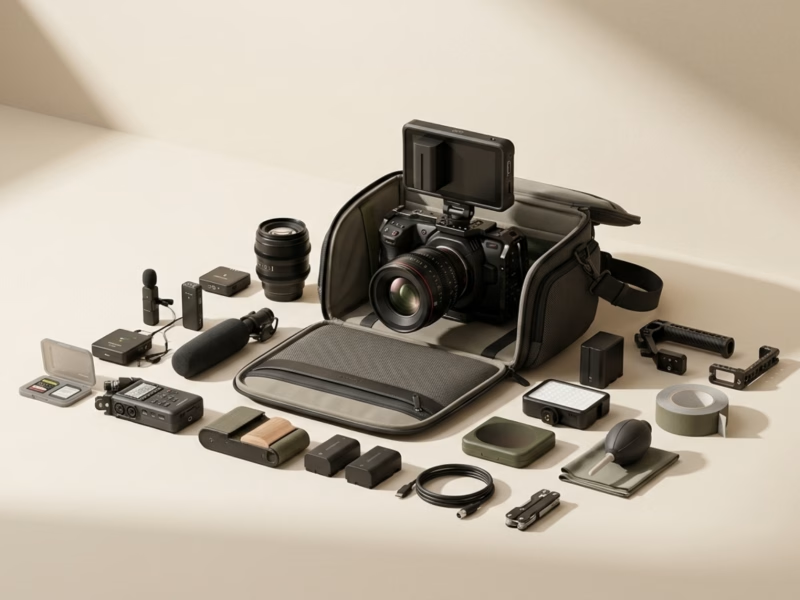
- Entry kit: camera, one lens, a basic tripod, and a shotgun microphone.
- Standard kit: two cameras, multiple lenses, wireless audio, and basic lighting.
- Premium kit: cinema camera, specialty lenses, FPV or gimbal rig, full lighting kit, and backup everything.
Video Conferencing Equipment: Where It Fits In The Tier Structure
Video conferencing equipment sits mostly outside the entry to premium production tier structure, since it solves a reliability problem rather than a creative one. A corporate client asking about video conferencing equipment usually needs certified, dependable hardware, not cinematic camera work.
Zoom’s own recommended hardware list outlines exactly what a reliable conferencing setup needs: a dedicated camera, microphone, and speaker selected for compatibility, a completely different priority list than any production tier above it, entry through premium alike.
Video Production AI: Does It Change What’s Included At Each Tier?
Video production AI tools have started appearing across every tier’s post production stage, though the effect is more pronounced the higher the tier climbs. No current AI tool replaces the camera operator or the crew coordination that defines each tier, but several genuinely speed up what happens after the footage is captured.
Adobe’s own release notes for Premiere Pro describe generative extend for lengthening clips and automated media search across footage libraries, both genuinely useful video production AI features that shorten post production timelines at the standard and premium tiers specifically, where the volume of footage to sort through is largest.
Consistent workflows across a crew still matter more than any single AI feature. Industry standards bodies that govern broadcast and cinema production exist in part because consistent roles and workflows, not any one tool, are what let multi camera, multi crew productions actually deliver on schedule, AI assisted or not.
The Bottom Line
As of 2026, video production services differ tier to tier in three measurable ways: crew size, camera and gear complexity, and post production depth, not just price on a quote. Match the tier to the actual deliverable, ask specifically what crew and gear a quote includes, and treat any proposal that skips those details as incomplete regardless of the number attached to it. A clear tier breakdown protects both sides of the booking.
Video Production Services: Quick Answers
How do I know which tier my project actually needs?
Match the tier to the deliverable’s complexity, not the budget alone. A single interview rarely needs premium gear, while a brand film rarely looks right shot on entry tier equipment.
Can a project mix tiers, like a premium camera with a smaller crew?
Sometimes, but mismatched tiers often create bottlenecks, since premium gear still needs enough hands to operate it properly. A reputable provider will flag this mismatch rather than just take the booking.
Does a higher tier always mean better final footage?
Not automatically, a well run entry tier shoot matched correctly to a simple deliverable can outperform a mismatched premium booking. Tier fit matters more than tier price alone.